 Medically reviewed by Dr. Yuvraj Monga, MBBS, MD, Indian HIV & STD specialist · Updated
Quick answer
The HIV window period is the time between an exposure and the point when a test can reliably detect HIV. It depends on the test: NAT (RNA) tests detect HIV about 10–33 days after exposure, 4th-generation antigen/antibody lab tests about 18–45 days (most infections by 6 weeks), and antibody-only tests, including most rapid and self-tests, about 23–90 days. A negative 4th-generation lab test at 6 weeks is reassuring for most people; a negative test at 12 weeks (3 months) is conclusive for nearly everyone.
What Is the HIV Window Period?
When HIV enters the body, it takes time before a test can find it. First, the virus multiplies quietly (sometimes called the eclipse period). Then a viral protein called p24 antigen appears in the blood, and finally the immune system makes antibodies (seroconversion). Each type of HIV test looks for one or more of these markers, so each has a different window period.
Testing inside the window period can give a negative result even when infection has happened. Testing after it gives an answer you can trust. That single idea explains why so many people test again and again: their first test was simply too early.
Window Periods by Test Type
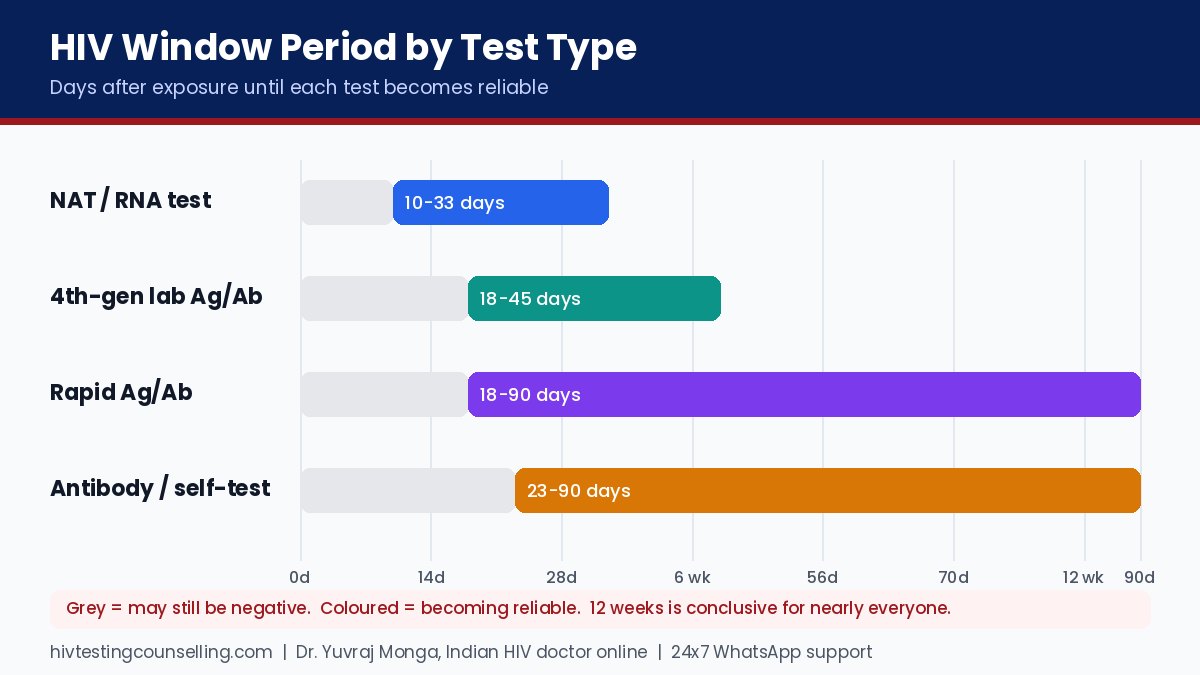
This chart summarises the window periods most guidelines use, including those of the US Centers for Disease Control and Prevention (CDC):
| Test | What it detects | Window period | Good to know |
|---|---|---|---|
| NAT / HIV RNA test | The virus's genetic material | About 10–33 days | Earliest test; used after high-risk exposures or to clarify unclear results. |
| 4th-generation antigen/antibody (lab) | p24 antigen + antibodies | About 18–45 days | The recommended standard test. Most infections show by 6 weeks. |
| Antigen/antibody (finger-prick rapid) | p24 antigen + antibodies | About 18–90 days | Less sensitive than the lab version early on. |
| Antibody-only (lab, rapid, self-test) | Antibodies only | About 23–90 days | Reliable from about 12 weeks. A reactive result needs confirmation. |
NAT (nucleic acid) tests
NAT tests look for HIV itself, so they turn positive earliest. They cost more and are not used for routine screening, but a doctor may order one after a high-risk exposure, when early symptoms appear, or when other results disagree.
4th-generation antigen/antibody tests
This is the test most doctors recommend. Because it detects both p24 antigen and antibodies, it closes the window much earlier than older tests. If you are unsure what your laboratory used, look for words like “HIV 1/2 Ag/Ab”, “combo” or “4th generation” on the report.
Antibody-only, rapid and self-tests
Many rapid tests and home self-tests detect antibodies only. They are accurate after the window period but can miss an infection that is only weeks old. Read our sister site's guide to how accurate home HIV testing kits are.
Window Period for Common HIV Test Names
Lab reports and clinics use many names for the same few test types. Find yours here:
| Test name you may see | Type | Reliable from about |
|---|---|---|
| HIV RNA PCR / NAT / viral load | Detects the virus's genetic material | 10–33 days |
| HIV DNA PCR (qualitative) | Detects viral DNA; mainly used for babies born to mothers with HIV | Not a routine adult screening test |
| HIV p24 antigen | A viral protein that appears about 2–3 weeks after infection | Used inside 4th-generation tests rather than alone |
| HIV 1/2 Ag/Ab, “combo”, 4th-gen ELISA or CLIA | p24 antigen + antibodies (lab) | 18–45 days; reassuring at 6 weeks |
| HIV card test / rapid test | Usually antibody-only (some detect antigen too) | 23–90 days; conclusive at 12 weeks |
| HIV Tri-Dot test (India) | Rapid antibody test showing separate dots for HIV-1 and HIV-2; a Tri-Dot + Ag version also detects antigen | Antibody version: conclusive at 12 weeks |
| 3rd-generation ELISA (antibody) | Antibodies only (lab) | 23–90 days |
| HIV self-test (oral or finger-prick) | Antibodies only | Conclusive at 12 weeks |
What is the maximum window period for HIV?
With modern tests, 12 weeks (3 months) is the maximum window period for almost everyone: a negative result at 12 weeks is conclusive. Older guidance sometimes mentioned 6 months; that is now only advised in special situations, such as testing during or soon after PEP or PrEP, which your doctor will explain.
HIV testing accuracy timeline, week by week
- Weeks 0–1: no test can reliably detect a new infection (the eclipse stage). If within 72 hours, consider PEP.
- Weeks 2–5: a NAT/RNA test may detect HIV; antigen appears in many people.
- Week 6: a 4th-generation lab test is reassuring for most people.
- Week 12: every standard test, including rapid, card, Tri-Dot and self-tests, is conclusive.
The early “window stage” or “window phase” of HIV is also when the viral load can be very high, so protect partners until you have a conclusive result.
When Should You Test After an Exposure?
For a single possible exposure, a simple, evidence-based plan avoids both false reassurance and unnecessary repeat tests:
- Within 72 hoursAsk a doctor whether you need PEP (post-exposure prophylaxis). A baseline HIV test is usually done when PEP starts.
- About 2 weeksGonorrhoea and chlamydia tests become reliable.
- About 6 weeks4th-generation HIV test and syphilis test. A negative result here is reassuring for most people.
- 12 weeks (3 months)Final HIV test if you took PEP, used an antibody-only test, or your doctor advises it.
Your personal plan depends on the type of exposure and the tests available to you. That is exactly what we work out together in a counselling session. For a deeper read, see HIV window period testing explained and when a retest after a negative result is really needed.
The Window Period After PEP or PrEP
After PEP: PEP medicines can delay the point at which an infection, if one occurred, becomes detectable. That is why follow-up HIV testing is recommended about 4–6 weeks and again about 12 weeks after the exposure, as described in CDC guidance on PEP. Don't stop PEP early because an early test is negative.
On PrEP: people taking PrEP are tested before starting and then every three months. If you miss doses and have a possible exposure, talk to your doctor about whether PEP or an extra test is needed.
Can an HIV Test Be Negative During the Window Period?
Yes. A test taken too early can be negative even though infection has occurred; this is called a false negative. It is not the test failing; it is the test being used before it can work. Signs that you should retest on the right date include:
- The test was taken before the window period for that test type.
- You had another possible exposure after the test.
- You develop a flu-like illness with fever, rash or swollen glands 2–4 weeks after an exposure (see early HIV symptoms).
- You took PEP and have not yet had the 12-week test.
False positives are rare, and every reactive screening test is confirmed with a different test before anyone is diagnosed.
Window Periods and Testing Where You Live
The science is the same everywhere, but where you test differs:
- India: free, confidential testing is available at government Integrated Counselling and Testing Centres (ICTCs) under the National AIDS Control Organisation (NACO), and at private laboratories. Dr. Monga can also arrange testing at his Delhi NCR clinics.
- USA: sexual health clinics, community clinics and private labs; see our USA city guides.
- Canada: provincial sexual health clinics, with reactive screens confirmed by provincial labs; see our Canada guides.
- Dubai & UAE: licensed laboratories regulated by the DHA, DoH or MOHAP; see our UAE guides.
Window Periods for Other STIs
After a possible exposure, HIV is rarely the only infection worth testing for. Other STIs have their own timing:
| Infection | Test | When it becomes reliable |
|---|---|---|
| Gonorrhoea & chlamydia | Urine, throat or rectal swab (NAAT) | About 2 weeks |
| Syphilis | Blood test | About 6 weeks; repeat at 12 weeks if advised |
| Hepatitis B | Blood test | About 6 weeks to 3 months |
| Hepatitis C | Antibody or RNA test | RNA from about 2 weeks; antibodies 8–11 weeks |
A combined plan saves time and repeat visits. Read why a combined STD and HIV panel makes sense and whether you can have an STD without symptoms.
Window Period Myths, Corrected
| Myth | Fact |
|---|---|
| “You must wait 6 months for an accurate result.” | Modern tests do not need 6 months. 12 weeks is conclusive for nearly everyone; 6 weeks with a 4th-generation lab test is reassuring for most. |
| “A negative test at 2 weeks means I'm fine.” | Too early for most tests. It can be negative even if infection occurred. |
| “If I have no symptoms, I don't need a test.” | Many people have no early symptoms at all. Only a correctly timed test gives the answer. |
| “Testing every week will tell me sooner.” | Repeated early tests add anxiety, not accuracy. Test on the right dates instead. |
How Counselling Helps During the Window Period
The weeks between an exposure and a conclusive result are often the hardest. Many people stop sleeping, search symptoms late at night and test repeatedly. Counselling with Dr. Yuvraj Monga, an Indian HIV specialist with more than 25 years of experience, gives you:
- An honest assessment of how risky the exposure actually was.
- A dated test plan, so one well-timed test replaces many anxious ones.
- Practical tools for anxiety while you wait (coping while waiting for results).
- A clear explanation of your report when it arrives.
Frequently Asked Questions
What is the maximum window period for HIV?
With modern tests, 12 weeks (3 months). A negative 4th-generation or antibody test at 12 weeks is conclusive for almost everyone; special situations such as testing after PEP follow your doctor's plan.
What is the window period of the HIV Tri-Dot test?
The standard Tri-Dot is a rapid antibody test, so it can miss early infection and is conclusive about 12 weeks after an exposure. A Tri-Dot + Ag version also detects antigen.
What is the window period of an HIV card test?
Most HIV card (rapid) tests detect antibodies and are conclusive about 12 weeks after exposure. A 4th-generation lab test gives a reliable answer earlier, from about 6 weeks.
What is the window period for the HIV p24 antigen test?
p24 antigen appears about 2 to 3 weeks after infection, which is why 4th-generation tests that combine antigen and antibody detection are reliable from about 18 to 45 days.
What is the window period for the HIV PCR test?
An HIV RNA PCR (NAT) test can detect HIV about 10 to 33 days after exposure. DNA PCR is mainly used for babies.
What is the HIV window period?
It is the time between a possible exposure to HIV and the point when a test can reliably detect the infection. It varies by test type, from about 10 days for NAT tests to about 90 days for antibody-only tests.
Is a negative HIV test at 6 weeks conclusive?
A negative 4th-generation antigen/antibody laboratory test at 6 weeks is reassuring for most people, because most infections are detectable by then. A final test at 12 weeks is recommended if you took PEP, used an antibody-only test, or your doctor advises it.
Is a negative HIV test at 3 months conclusive?
Yes, for nearly everyone. A negative result at 12 weeks (3 months) after the last possible exposure is considered conclusive with standard tests, unless you had another exposure since.
How soon can an HIV test detect infection?
NAT (RNA) tests can detect HIV from about 10 to 33 days after exposure; 4th-generation antigen/antibody lab tests from about 18 to 45 days.
Does PEP change the window period?
PEP can delay detection if an infection occurred, so follow-up testing is recommended about 4 to 6 weeks and 12 weeks after the exposure.
Can I pass on HIV during the window period?
Yes. Viral levels can be very high soon after infection, so use condoms and avoid sharing needles until you have a conclusive result.
Are home HIV self-tests accurate?
Most self-tests detect antibodies only. They are accurate after about 12 weeks; a reactive self-test must be confirmed with a laboratory test.
Can I talk to an Indian HIV doctor online about my test timing?
Yes. Dr. Yuvraj Monga counsels people worldwide on WhatsApp, voice or video, with 24x7 support. He can plan your test dates and explain your results.
Sources and Further Reading
From our sister site, PEP Treatment for HIV
Related guides
Online HIV counselling where you live
Medical note: This guide is for education and does not replace a consultation with a doctor. If an exposure happened in the last 72 hours, seek PEP at a hospital or clinic now. Outside India, tests and prescriptions come from a provider licensed where you live.