 Medically reviewed by Dr. Yuvraj Monga, MBBS, MD, Indian HIV & STD specialist · Updated
Quick answer
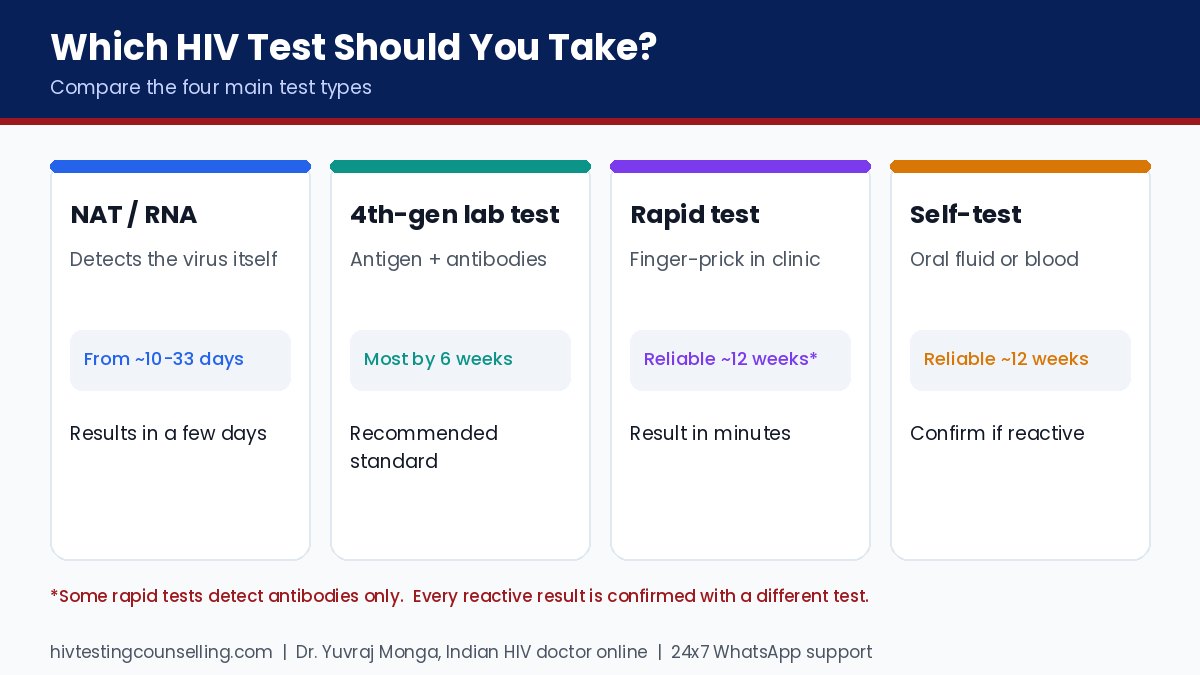
The earliest reliable HIV test is a NAT (RNA) test, from about 10–33 days after exposure. The test most doctors recommend is the 4th-generation antigen/antibody lab test, which detects most infections by 6 weeks. Rapid and home tests are convenient but are reliable only from about 12 weeks. Every reactive result is confirmed with a second, different test. If the exposure was in the last 72 hours, ask a doctor about PEP first.
Why Test Early?
Testing early, at the right time, is one of the most powerful things you can do for your health. A diagnosis made early means treatment can start before the immune system is damaged, and people who start treatment early can expect a near-normal life expectancy. Early testing also protects partners: once treatment makes the viral load undetectable, HIV is not passed on through sex (U=U).
And for the far larger number of people whose result is negative, a correctly timed test ends weeks of uncertainty.
Types of HIV Tests Compared
| Test | Sample | Detects | Reliable from | Time to result |
|---|---|---|---|---|
| NAT / HIV RNA | Blood (lab) | The virus itself | About 10–33 days | Usually a few days |
| 4th-generation Ag/Ab | Blood (lab) | p24 antigen + antibodies | About 18–45 days | Often 1–3 days |
| Rapid test | Finger-prick blood | Antibodies (some also antigen) | About 18–90 days | About 1–20 minutes |
| Self-test | Oral fluid or finger-prick | Antibodies | About 12 weeks | About 1–20 minutes |
Want the full picture on timing? Our HIV window period guide explains each test in detail.
What Is the Earliest HIV Test After an Exposure?
If you need an answer as early as possible, for example after a high-risk exposure or if you develop flu-like symptoms, a doctor may suggest a NAT test from about 10 days. For most people, though, the best plan is simpler:
- 0–72 hoursSpeak to a doctor about PEP. This matters more than any test.
- 6 weeksA 4th-generation antigen/antibody lab test, plus a syphilis test.
- 12 weeksA final test if you took PEP, used a rapid or self-test, or your doctor recommends it.
Our sister site explains what to do in the first 72 hours after an exposure.
How Accurate Are HIV Tests?
After the window period, modern HIV tests are extremely accurate: they find more than 99% of infections, and confirmed results are very reliable. Two facts matter most:
- A reactive screening test is not a diagnosis. It is always confirmed with a different test, and often a fresh sample, before anyone is told they have HIV.
- A non-reactive test is only conclusive after the window period for that test type. Tested too early, it can miss an infection.
Where to Get an HIV Test
In India
Free and confidential testing is offered at government Integrated Counselling and Testing Centres (ICTCs) under NACO, at many government hospitals, and at private diagnostic laboratories. In India, a positive result is confirmed using a strategy of three different tests. Dr. Yuvraj Monga also offers testing and counselling at his clinics in Lajpat Nagar, Dwarka and Gurugram (see HIV care in India).
In the USA, Canada and the UAE
Sexual health clinics, community clinics, hospitals and licensed laboratories offer HIV testing. Local options, costs and privacy rules differ by place, so we have written detailed guides: 100 US cities, 40 Canadian cities and Dubai and every UAE emirate.
At home
Where approved, HIV self-tests offer privacy, but most detect antibodies only. Use them from 12 weeks, and confirm any reactive result in a laboratory.
Test for Other STIs at the Same Time
Syphilis, gonorrhoea and chlamydia are common, often silent, and they raise the risk of HIV transmission. Whenever you test for HIV after an exposure, ask about:
- Gonorrhoea and chlamydia from about 2 weeks, on urine and, depending on the type of sex, throat or rectal swabs.
- Syphilis from about 6 weeks, with a repeat at 12 weeks if advised.
- Hepatitis B and C, especially after needle sharing or if you are not vaccinated against hepatitis B.
Our sister site explains how STDs raise HIV risk.
HIV Testing in Pregnancy
HIV testing is a routine part of antenatal care in India and most countries. Finding HIV early in pregnancy matters: with treatment, the chance of passing HIV to the baby becomes very small, and babies can be born HIV-negative. If you are pregnant or planning a pregnancy and worried about a past exposure, test early and ask for counselling so you understand every result.
Testing as an NRI, Expat or Traveller
If you live outside India, or had an exposure while travelling, you have two good options: test locally at a licensed clinic, or test during a trip to India. Either way, the window period is what decides when a result is reliable. Many people consult an Indian HIV doctor online first to plan the right test, then test where it is most convenient. Read HIV testing and PEP for NRIs and expats and what to do after an exposure abroad.
Privacy, Cost and Confidentiality
HIV testing is confidential in India and in most countries. In India, government ICTCs offer free testing with counselling, and private laboratories offer quick, discreet testing for a fee. Before you test, ask how the result will be shared with you and who else, if anyone, will see it. If privacy worries are stopping you from testing at all, a confidential counselling session can help you choose the option you are most comfortable with.
How to Prepare for an HIV Test
- Note the date of the possible exposure and of any earlier tests.
- Ask which test is used: 4th-generation antigen/antibody, antibody-only or NAT.
- Ask how and when you will receive the result.
- Test for other STIs at the same visit: syphilis, gonorrhoea and chlamydia often have no symptoms.
- Bring your questions, or book pre-test counselling so you know what each possible result will mean.
Understanding Your Result
Non-reactive
No HIV found by that test. Final if taken after the window period; otherwise retest on the right date.
Indeterminate
An unclear result. Usually a non-specific reaction; a repeat test or NAT a few weeks later settles it.
Reactive
Needs confirmation with a different test. If confirmed, treatment works, and an undetectable viral load protects partners.
Post-test counselling explains your report line by line. Read about viral load and CD4 counts and HIV treatment.
Frequently Asked Questions
What is the earliest HIV test after exposure?
A NAT (HIV RNA) test can detect infection from about 10 to 33 days after exposure. For routine testing, a 4th-generation antigen/antibody lab test at 6 weeks is recommended.
Which HIV test is best?
For most people, the 4th-generation antigen/antibody laboratory test. It detects most infections by 6 weeks and is widely available.
Is a rapid HIV test accurate?
Yes, after its window period. Many rapid tests detect antibodies only and are reliable from about 12 weeks. A reactive rapid test must be confirmed in a laboratory.
Where can I get a free HIV test in India?
At government Integrated Counselling and Testing Centres (ICTCs) and many government hospitals, under the National AIDS Control Programme.
Should I test for other STDs at the same time?
Yes. Syphilis, gonorrhoea and chlamydia often cause no symptoms and raise HIV risk, so a combined test plan is best.
Do I need counselling before an HIV test?
Counselling is strongly recommended. Pre-test counselling makes sure you choose the right test and timing; post-test counselling explains your result.
Can I consult an Indian doctor online about which test to take?
Yes. Dr. Yuvraj Monga, an Indian HIV specialist, consults online worldwide with 24x7 WhatsApp support.
Sources and Further Reading
Trusted sources
From our sister site, PEP Treatment for HIV
Related guides
Online HIV counselling where you live
Medical note: This guide is for education and does not replace a consultation with a doctor. If an exposure happened in the last 72 hours, seek PEP at a hospital or clinic now. Outside India, tests and prescriptions come from a provider licensed where you live.