On this page
Why People Across Canada Talk to Us
Canada has excellent HIV care, but getting to it is not always quick. A family doctor may be weeks away, walk-in clinics are busy, and specialists usually need a referral. In the meantime, the questions that matter most, was this risky, which test do I need, how long will results take, and what does this report mean, often go unanswered. That is where HIV counselling in Canada with Dr. Monga comes in.
Popular city guides: Toronto, Vancouver, Montreal, Calgary, Brampton, Surrey, Ottawa and Edmonton. Prefer to talk first? See our counselling services or contact us privately.
The HIV Testing Counselling program offers private, one-to-one counselling with Dr. Yuvraj Monga for people anywhere in Canada. We focus on the whole testing journey: pre-test counselling before you test, support while you wait, and post-test counselling once your result arrives, whatever it says.
In short
- Online HIV and STD counselling with Dr. Yuvraj Monga is available anywhere in Canada for US$99.
- Routine lab HIV results usually take a few days to about two weeks; a reactive screen is always confirmed by a provincial public health lab.
- PrEP coverage depends on your province: free in British Columbia, funded in Alberta, OHIP+ for under-25s in Ontario and RAMQ-covered in Quebec.
- For an exposure in the last 72 hours, go to a hospital emergency department for PEP now.
Run by Dr. Yuvraj Monga, HIV, AIDS & STD Specialist
The HIV Testing Counselling program is run by Dr. Yuvraj Monga, MBBS, MD, an HIV, AIDS and STD specialist physician with a fellowship in infectious diseases and more than 25 years of experience managing and treating patients from around the world. Every consultation follows WHO guidance on HIV testing services, and our EXACT approach means we look at the person, not just the test result.
- Indian Achievers Award (2014)
- Brand Achiever, Health Care Excellence Awards (2015)
- Indian Achievers Award for Best Clinic in Delhi-NCR (2017)
Easy consultation, friendly follow-up. We were among the first to build a counselling program around the full journey of exposure, anxiety, counselling, testing and treatment.
HIV Counselling Guides for 40 Canadian Cities
Choose your city for local services, results times, time-zone conversion and FAQs:
Manitoba
Ontario
New Brunswick
Nova Scotia
Prince Edward Island
Newfoundland and Labrador
Yukon
Northwest Territories
Nunavut
Pre- and Post-HIV Test Counselling: What's the Difference?
Counselling is part of good HIV testing, not an optional extra. Pre-test counselling (or a briefer pre-test discussion) prepares you before blood is drawn. Post-test counselling happens when the result comes back and turns a number on a report into a plan. In Canada, clinics usually offer a short version of both; a dedicated session gives you time to ask everything.
| Pre-test counselling | Post-test counselling | |
|---|---|---|
| Purpose | Prepare you to test with confidence | Make sure you understand and act on the result |
| Includes | Exposure review, choice of lab, rapid or self-test, how and when you'll get results | Result explained, need for repeat tests, prevention plan, support and referrals |
| Emotional focus | Easing fear before testing | Coping with relief, uncertainty or a new diagnosis |
| Required? | Informed consent is essential; full counselling is optional | Strongly recommended for everyone, essential after a reactive test |
| Duration | A few minutes to a quarter of an hour | Anywhere from 15 minutes to an hour |
What is post-test counselling, in plain words?
It is the part of HIV testing that answers “So what does this mean for me?” A counsellor or doctor explains your result in light of your exposure date and test type, tells you whether you need a repeat test, and, if the result is reactive, walks you through confirmation, treatment and who to tell. Done well, it prevents both false reassurance and unnecessary panic.
HIV screening test counselling
A screening test is the first test in the sequence, whether a lab blood test, a clinic rapid test or a self-test. Screening test counselling makes sure you know that a non-reactive screen is conclusive only after the window period, and that a reactive screen is not yet a diagnosis. Those two facts alone prevent most of the distress we see.
See how a session runs step by step in our counselling process, or read about early HIV testing options.
HIV Test Results Time in Canada
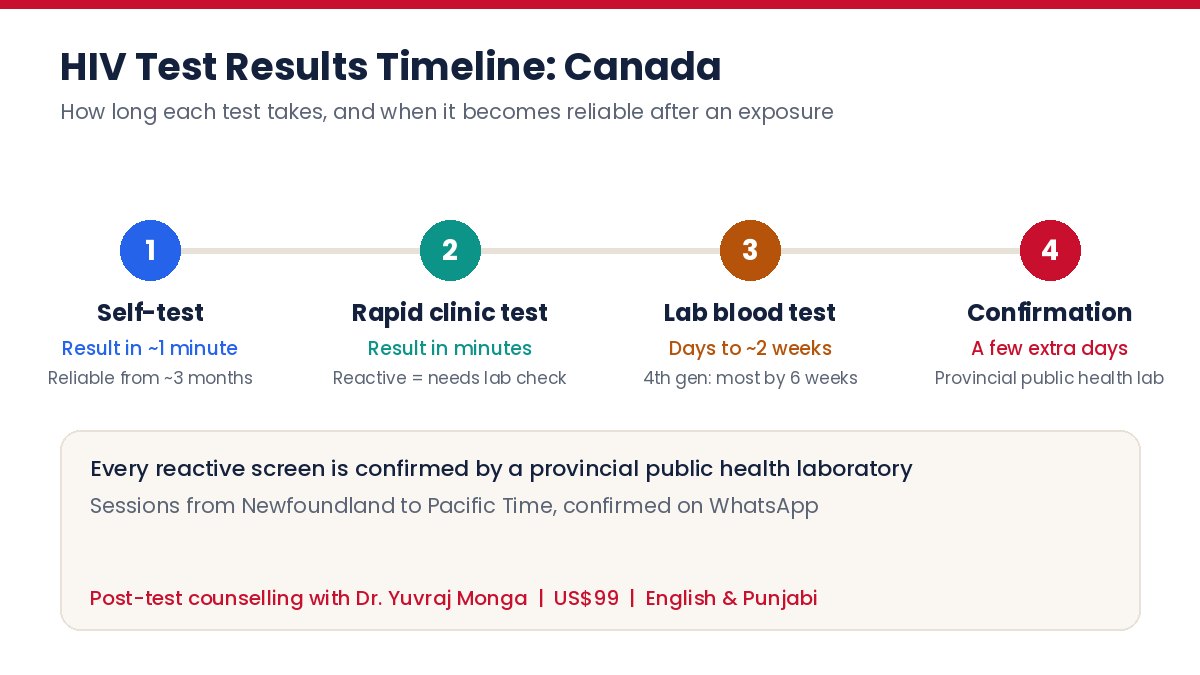
Two different clocks matter: how soon after exposure a test can detect HIV (the window period), and how long the result takes to reach you. Both vary by test type. In Canada, a typical picture looks like this:
- Minutes
HIV self-test
The INSTI HIV self-test, approved by Health Canada, shows a result in about one minute. Because it detects antibodies, it is conclusive from about 3 months after an exposure.
- Minutes
Rapid point-of-care test
Many clinics in Canada offer a finger-prick rapid test with results during the visit. A reactive rapid test always needs a lab blood test to confirm it.
- Several days
Standard lab screening
The antigen/antibody test ordered by a doctor, nurse practitioner or sexual health clinic in Canada. Accurate for most people from 6 weeks after exposure. Ask how results are shared: many Canada clinics call only if something needs follow-up, so confirm the plan.
- A few more days
Supplementary testing
A reactive screen goes to the provincial public health laboratory for a different confirmatory assay, sometimes with an HIV RNA test.
No news is usually just a busy lab, not bad news. If you are on PEP, your doctor will usually plan HIV tests about 4–6 weeks and 3 months after the exposure, and those dates matter more than how fast any single result arrives.
Considering a self-test first? Read what home HIV testing kits can and cannot tell you, and our own guide to the HIV window period.
What Test Is Used to Confirm a Diagnosis of HIV?
No one in Canada is diagnosed with HIV on the basis of a single screening test. Every reactive result goes through confirmation, and in Canada that happens at the provincial public health laboratory. So, what test is used to confirm a diagnosis of HIV? The sequence usually looks like this:
The screen
Highly sensitive by design. It flags anything that might be HIV, which is why a small number of reactive screens turn out negative on confirmation.
Supplementary test
At the provincial public health laboratory, a reactive screen is re-tested with a different assay, usually an HIV-1/HIV-2 antibody differentiation test. The older Western blot has largely been replaced.
Viral RNA when unclear
When the first two disagree, a nucleic acid test looks directly for HIV genetic material. It also detects very early infection.
Baseline tests
Once HIV is confirmed, an HIV specialist orders CD4 count, viral load and resistance testing to plan treatment.
HIV serology test counselling for Canada
Send us a photo of your report (you can cover your name) and we will explain the assay names, the cut-off values, the interpretation and what happens next. Many people find that once they understand the wording, the fear eases considerably.
Post-Test Counselling for HIV: What Happens After Each Result
Post-test counselling looks different depending on what the report says. Here is what we cover for each result, for people in Canada and everywhere else:
Non-reactive (negative)
A non-reactive result is reassuring, but only conclusive if the test was done late enough. We check the date and test type with you, plan any final retest and then help you close the chapter, which for many anxious people is the hardest part.
- Can I stop worrying now?
- Should my partner test too?
- How often should I test in future?
Indeterminate
An indeterminate result means the lab could not give a clear answer. It can happen very early in an infection, but more often it is a non-specific reaction in someone without HIV. The lab will ask for a repeat sample, usually within a few weeks. Waiting is difficult, and support during this time matters.
- Could this be a false reaction?
- Will an RNA test help?
- Should I avoid sex until it's clear?
Reactive / confirmed positive
A confirmed positive result is life-changing news, but HIV today is a manageable long-term condition. With treatment, people living with HIV can expect a near-normal lifespan, and an undetectable viral load means HIV is not passed on through sex. In Canada, public health may contact you to help notify partners confidentially. Counselling helps with the shock, with disclosure and with starting care.
- What does U=U mean for me?
- Does public health contact partners?
- Where do I get specialist care?
Waiting is often the hardest part: these practical tools for coping while you wait for HIV results can help. If your result is confirmed positive, read about HIV treatment options, viral load and CD4 counts and the HIV care continuum, from diagnosis to undetectable.
Questions about HIV disclosure and the law in Canada are complex. For legal advice, contact a legal clinic such as the HIV & AIDS Legal Clinic Ontario (HALCO) or the HIV Legal Network.
The EXACT Program
EXposure, Anxiety, Counselling, Testing & Treatment: one confidential pathway from the moment of worry to a clear answer.
- EX
Exposure
Honest risk assessment, never exaggerated, never dismissed.
- A
Anxiety
Support for the sleepless nights and constant checking that often follow a scare.
- C
Counselling
Private sessions on risk, relationships, disclosure and living well.
- T
Testing & Treatment
Clear testing timelines and help with PEP, PrEP or ART alongside your local care.
Infectious Disease Doctors in Canada: How to Reach One
In Canada, HIV specialist care is usually led by infectious disease physicians or dedicated HIV clinics in teaching hospitals and community health centres. You generally need a referral from a family doctor, nurse practitioner or walk-in clinic to see a specialist, though sexual health clinics can test you without one. Each city guide below lists the main HIV and infectious disease services in that area.
PrEP Coverage Across Canada, Province by Province
PrEP coverage is one of the most confusing parts of HIV prevention in Canada, because it depends on where you live:
| Province / territory | PrEP coverage (check current rules) |
|---|---|
| British Columbia | Free for MSP enrollees through the BC Centre for Excellence in HIV/AIDS. |
| Alberta | Publicly funded for eligible residents with Alberta Health Care coverage. |
| Saskatchewan | Covered under the provincial drug plan for people who meet clinical criteria. |
| Ontario | OHIP+ for those 24 and under without private insurance; Trillium, ODSP, Ontario Works, ODB (65+) or private plans for others. |
| Quebec | Covered by RAMQ public drug insurance or private group plans, with the usual deductible and coinsurance. |
| Manitoba & Atlantic provinces | Prescribed through sexual health and primary care clinics; ask about provincial Pharmacare or drug plans and private insurance. |
| Territories | Prescribed through territorial health services; NIHB covers eligible First Nations and Inuit clients. |
HIV in Brief: What It Is, Symptoms, and Why Early Advice Matters
What is HIV?
The human immunodeficiency virus gradually depletes the white blood cells (CD4 cells) that coordinate the body's defences. Transmission needs a specific route: condomless anal or vaginal sex, shared needles, or from parent to baby. Everyday contact does not spread it. AIDS is the late stage of untreated HIV, which modern treatment now prevents.
Symptoms to know about
Early HIV, called acute or primary infection, sometimes causes fever, rash and swollen glands for a week or two. Just as often it is silent. Symptom-checking online usually increases anxiety without giving an answer; a correctly timed test does both.
- Rash
- Swollen lymph nodes
- Muscle aches
- Fatigue
- Night sweats
- Mouth ulcers
- Fever
- Sore throat
Read more about HIV basics, early HIV symptoms, high-risk exposures and when to consult a doctor.
Why consult early?
Time-sensitive prevention
PEP must begin within three days. Talking to someone early is how people find out whether they need it.
Better long-term health
People diagnosed and treated early have near-normal life expectancy.
Undetectable = untransmittable
Treatment that suppresses the virus also prevents sexual transmission.
Silent STIs
Syphilis, gonorrhoea and chlamydia often cause no symptoms and raise HIV risk, so they belong in the same test plan.
Following WHO Guidelines: The 5 Cs of HIV Testing
Our counselling follows WHO guidelines on HIV testing services. They boil down to five words, the 5 Cs, which you can expect from any good testing service in Canada:
Consent
Testing is voluntary, and you agree to it after clear information.
Confidentiality
Your result and conversation stay private.
Counselling
Clear information before, and support after, every test.
Correct results
Testing done to standard, with no diagnosis from a single test.
Connection
Linkage to prevention, treatment and care after the test.
When You Need Counselling: Our Services for Canada
Here is what we can help with. Every session is private, booked on WhatsApp and timed for Eastern Time:
Looking for HIV counselling in Canada for something specific? See the full list of our counselling services.
Managing PEP side effects
Feeling queasy
A light snack with each dose often helps; your prescriber can add an anti-nausea tablet.
Bloating & stomach upset
Lighter, less oily meals and a short walk after eating.
Loose stools
Fluids or oral rehydration; seek help if it lasts over two days.
Low energy
Rest well and take PEP at the same time every day.
Fever or rash
Not expected from PEP. Get checked promptly, since it may signal another illness.
Talk to your prescriber before stopping PEP. Go to emergency care for a fever with rash, jaundice, dark urine, severe belly pain or vomiting you cannot stop.

Dr. Yuvraj Monga, MBBS, MD
MBBS, MD (Pharmacology) · Fellowship in Infectious Diseases (Australia) · 25+ years managing HIV, AIDS & STDs
Over a quarter of a century, Dr. Monga has managed and treated HIV, AIDS and STDs for patients from India and abroad. His focus with clients in Canada is simple: accurate information, realistic timelines and steady support until the uncertainty is over.
- HIV testing & counselling
- PEP & PrEP guidance
- ART coordination, CD4 & viral load monitoring
- STD/STI testing & treatment
- HIV anxiety counselling
- LGBTQ+ affirming care
- Relationship & marriage counselling
Booking a Session: How It Works and What Time It Will Be
- Say hello Send a WhatsApp message from Canada.
- Book We confirm the time in Eastern Time.
- Your session Private chat, audio or video.
- Follow-up Written next steps and test dates.
| In Canada | India (IST), winter | India (IST), summer |
|---|---|---|
| 7:00 AM | 5:30 PM | 4:30 PM |
| 12:00 PM | 10:30 PM | 9:30 PM |
| 5:00 PM | 3:30 AM (next day) | 2:30 AM (next day) |
| 9:00 PM | 7:30 AM (next day) | 6:30 AM (next day) |
Times shown for Eastern Time (Toronto, Ottawa, Montreal). Each city page shows its own time zone, from Newfoundland Time to Pacific Time.
Act Before the Virus Gets Ahead of You
PEP only works in the first 72 hours, and every week of untreated HIV costs immune strength. If you're worried, waiting or newly diagnosed, book your consultation now and fix your appointment in your own time zone.
Ask Dr. Monga a Question
Tell us briefly what is worrying you. We receive it by email, and WhatsApp opens with the same message so you can send it straight away.
- 100% confidential
- Talk in English or Punjabi (Hindi too)
- US$99 counselling package, confirmed before payment
- Sessions in Eastern Time
HIV Testing and Counselling Questions from Canada
Who are the best doctors for HIV/AIDS in Canada?
Canada's leading HIV care is provided by infectious disease physicians and HIV clinics in teaching hospitals and community health centres. Each of our city guides lists the main local services. Counselling with Dr. Yuvraj Monga helps you prepare before you choose.
Is Dr. Monga an infectious disease doctor?
Dr. Yuvraj Monga is an HIV, AIDS and STD specialist physician (MBBS, MD) with a fellowship in infectious diseases and more than 25 years of experience. He provides online counselling, education and guidance from India. Tests and prescriptions in Canada must come from a locally licensed provider.
How long do HIV test results take in Canada?
Self-tests and rapid clinic tests give results in minutes. A standard lab blood test usually takes from a few days to about two weeks. If the screen is reactive, confirmation at the provincial public health laboratory adds a few more days.
Where can I get PEP in Canada at night or on weekends?
Go to a hospital emergency department and ask for an HIV PEP assessment. PEP must start within 72 hours of the exposure, and the sooner the better.
What is post-test counselling for HIV?
Post-test counselling is the discussion held when you receive an HIV test result. It makes sure you understand the result correctly, decides whether you need a repeat test, plans prevention, and, if the result is reactive, offers support and a quick link to specialist care.
Is PrEP covered in Canada?
It depends on your province: free in British Columbia for MSP members, funded in Alberta, covered by OHIP+ for Ontarians 24 and under without private insurance, and covered under RAMQ in Quebec. Check your provincial plan, workplace insurance or NIHB.
What is HIV serology test counselling?
Serology tests look for HIV antibodies and antigen in the blood. Serology test counselling explains your lab report, including terms like reactive, non-reactive and indeterminate, and what the final interpretation means.
Is an HIV self-test reliable?
The INSTI HIV self-test approved in Canada is accurate for antibodies, but it can miss very recent infections. It is reliable from about 3 months after an exposure. A reactive self-test must be confirmed with a lab test.
Is counselling required before an HIV screening test?
WHO recommends that everyone receives clear pre-test information and gives informed consent; a longer counselling session is optional but helpful if you are anxious. Post-test counselling is important for every result, and essential for a reactive one.
How much does online counselling cost?
For people in Canada, the online counselling package with Dr. Yuvraj Monga is US$99. We confirm exactly what is included on WhatsApp before any payment.
Can I talk to Dr. Monga in Punjabi?
Yes. For people in Canada, sessions are available in English and Punjabi, and in Hindi too. Just mention your preferred language when you message us on WhatsApp.
What time are sessions for Canada?
Sessions are booked in your local time, from Newfoundland to Pacific Time. India is 8.5 to 13.5 hours ahead depending on your province and the season.
Further Reading
Doctor-reviewed guides
From our sister site, PEP Treatment for HIV:
- HIV window period testing When a result is reliable
- Home HIV testing kits Accuracy and timing
- Who should consider PrEP Planned prevention
- HIV testing and PEP for NRIs Care when you visit India
Official resources
- Government of Canada: HIV and AIDS National information
- CATIE Canada's source for HIV and hepatitis C information
- WHO: HIV and AIDS Global guidance
- 9-8-8 Suicide Crisis Helpline Call or text 9-8-8
Related searches
On this site: early HIV testing · window period · PEP · viral load & CD4 · worldwide counselling · USA · India · Dubai & UAE
Medical note: Dr. Monga HIV Counselling Center provides online counselling, education and guidance from India. It does not replace an in-person examination, laboratory testing or prescriptions from a provider licensed in your province. If an exposure happened in the last 72 hours, seek PEP at a hospital emergency department now. If you are in crisis or thinking about harming yourself, call or text 9-8-8.