 Medically reviewed by Dr. Yuvraj Monga, MBBS, MD, Indian HIV & STD specialist · Updated
Quick answer
HIV is treated with antiretroviral therapy (ART), usually one tablet a day, started as soon as possible after diagnosis. ART cannot cure HIV, but it stops the virus multiplying; most people reach an undetectable viral load within about six months, and an undetectable viral load means HIV is not passed on through sex (U=U). Two medicines also prevent HIV: PEP, a 28-day course started within 72 hours after an exposure, and PrEP, taken before exposure by people at ongoing risk.
Prevention and Treatment at a Glance
Modern HIV medicine works at every stage. Before an exposure, PrEP prevents infection. Just after an exposure, PEP can stop HIV taking hold. And if HIV is diagnosed, ART controls it for life. All three use antiretroviral medicines, but they are taken by different people, at different times, for different reasons.
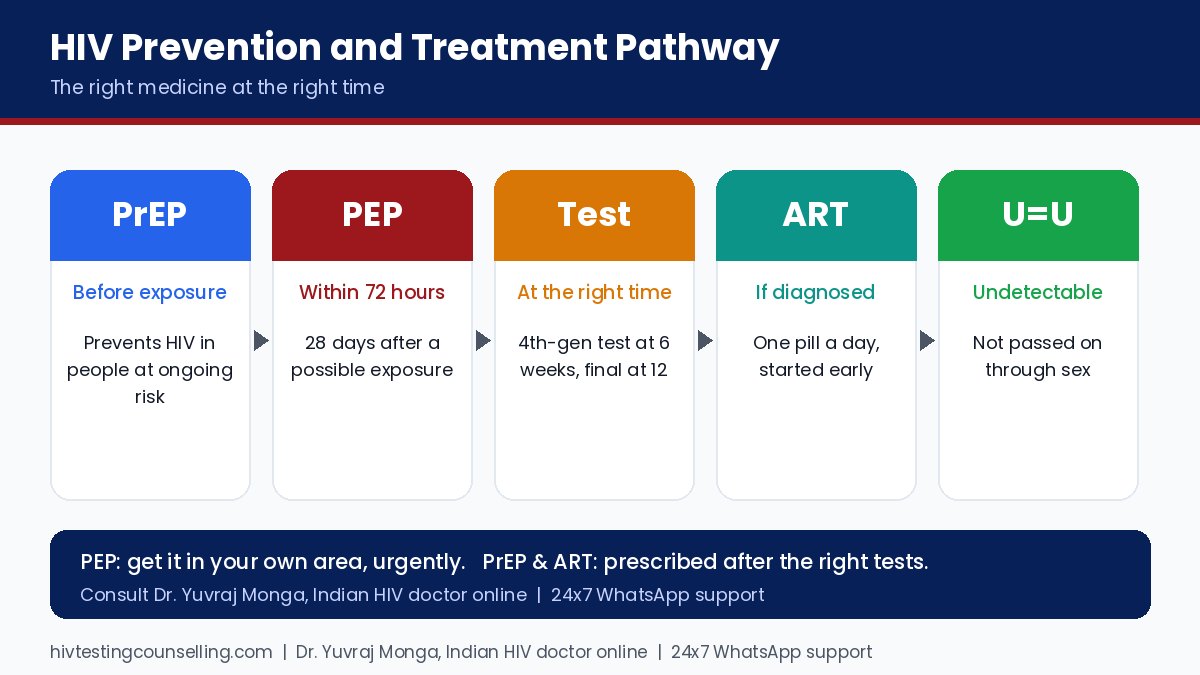
| PrEP | PEP | ART | |
|---|---|---|---|
| Who it's for | HIV-negative people at ongoing risk | HIV-negative people after a possible exposure | People living with HIV |
| When | Before exposure, daily or event-based | Within 72 hours, for 28 days | As soon as possible after diagnosis, for life |
| Purpose | Prevent HIV | Prevent HIV after an exposure | Control HIV and protect health |
| Where to get it | Doctor's prescription after baseline tests | Hospital or clinic in your own area, urgently | HIV specialist or ART centre |
PEP: Emergency Treatment Within 72 Hours
PEP (post-exposure prophylaxis) is a 28-day course of antiretroviral medicines that can prevent HIV after a possible exposure, such as a condom break, condomless sex with a partner of unknown status, shared needles or a needle-stick injury. It must start within 72 hours, and the sooner the better.
- Get PEP locally, immediately: go to a hospital emergency department or sexual health clinic in your own area. In India, PEP is available at government hospitals and through private doctors.
- Take every dose for 28 days; don't stop early because you feel well or an early test is negative.
- Manage side effects: nausea, bloating and tiredness are common early and usually settle. Read PEP side effects and how to manage them.
- Test afterwards: about 4–6 weeks and 12 weeks after the exposure; see the window period guide.
PrEP: Preventing HIV Before Exposure
What is PrEP?
PrEP (pre-exposure prophylaxis) is medicine that people without HIV take before a possible exposure to prevent HIV. The most common form is a daily tablet containing tenofovir and emtricitabine. Taken as prescribed, PrEP reduces the risk of getting HIV from sex by about 99%, according to the US CDC. It does not protect against other STIs, so condoms and regular STI testing still matter.
Who should consider PrEP?
- You have a partner living with HIV who is not yet undetectable.
- You have new or multiple partners and don't always use condoms.
- You have had an STI in the past six months.
- You have needed PEP more than once.
- You share needles or injecting equipment.
How and when do you take it?
- Daily PrEP: one tablet every day, for anyone at ongoing risk.
- Event-based (2-1-1) PrEP: an option for some men who have sex with men, timed around sex. Your doctor will tell you if it suits you.
- Before starting: a negative HIV test, plus kidney and hepatitis B checks.
- While on PrEP: HIV, STI and kidney tests about every three months.
PrEP is not PEP. PrEP is taken before exposure. If you have already had an exposure in the last 72 hours, you need PEP: please consult a doctor or hospital in your own area immediately. Read PEP vs PrEP and who should consider PrEP.
Why consult an Indian HIV doctor about PrEP?
- Experience: Dr. Yuvraj Monga has more than 25 years in HIV, AIDS and STD care, with patients from around the world.
- Affordable: medical care in India costs far less than private care in most countries, and generic PrEP made in India is among the most affordable anywhere.
- Clear guidance: in counselling, Dr. Monga explains whether PrEP suits you, which tests you need, and the costs and options in your country compared with India.
- Complete confidentiality: counselling, prescription and follow-up, privately.
Getting your PrEP medicine
After a consultation and baseline tests, Dr. Monga can prescribe PrEP. Medicines are couriered anywhere in India, and for clients abroad we discuss the safest legal way to get your PrEP during the consultation.
Rules on importing prescription medicines differ by country. Where your country permits personal import of prescribed medicine, we can discuss dispatch options with you; otherwise, many clients collect PrEP during a visit to India.
Our vision: a life free of HIV for everyone we counsel, through prevention, early testing and the right treatment.
ART: Treatment for People Living With HIV
Antiretroviral therapy (ART) is a combination of HIV medicines that stops the virus from multiplying. WHO recommends starting ART for everyone diagnosed with HIV, as soon as possible, regardless of CD4 count. Starting early protects the immune system and keeps life expectancy close to normal.
What does treatment look like?
For most people today, ART is one tablet once a day. A widely used first-line regimen, recommended by WHO and used in India's national programme, combines tenofovir, lamivudine and dolutegravir (often called TLD). Your doctor chooses the regimen based on your tests, other conditions, pregnancy plans and possible drug interactions.
Side effects
Modern ART is generally well tolerated. Some people have mild nausea, headache, sleep changes or tiredness in the first weeks. Never stop or change ART on your own; talk to your doctor, because there is almost always a solution.
Adherence: the key to success
Taking ART every day, at about the same time, keeps the virus suppressed. Missing doses repeatedly can allow drug resistance. Practical tips, reminders and support make a real difference: read staying on track with HIV medication.
Monitoring: Viral Load, CD4 and Routine Tests
| Test | What it shows | Typical timing |
|---|---|---|
| Viral load | How much HIV is in the blood; the goal is undetectable | Around 6 months after starting, at 12 months, then usually yearly once stable |
| CD4 count | Immune strength | At diagnosis and as your doctor advises |
| Kidney, liver, blood sugar, lipids | Overall health and medicine safety | Before starting and periodically |
| Other infections | Hepatitis B and C, TB, STIs | At diagnosis and as needed |
Learn how to read your results in our guide to viral load and CD4 counts.
U=U: Undetectable Equals Untransmittable
U=U has transformed relationships, family planning and stigma. It also means that a partner who is undetectable on treatment is one of the most effective forms of HIV prevention there is. Read the HIV care continuum, from diagnosis to undetectable.
Long-Term Care: Living Well With HIV
- Regular check-ups every few months at first, then less often once stable.
- Vaccinations such as hepatitis B, flu and pneumococcal vaccines, as advised.
- Heart, bone and metabolic health: exercise, a balanced diet, no smoking and limited alcohol.
- Mental health: counselling for diagnosis shock, disclosure, relationships and stigma.
- Family planning: with treatment, people living with HIV can have HIV-negative children.
When Treatment Isn't Working
If the viral load does not become undetectable, or rises again, your doctor will check whether doses are being missed, whether other medicines interact with ART, and whether the virus has developed resistance. A resistance test guides a change of regimen. Treatment failure is uncommon with good adherence, and switching regimens works for most people.
Where to Get HIV Treatment
In India: ART is provided free of charge at government ART centres under NACO, and by private HIV specialists. Dr. Yuvraj Monga sees patients in person at his clinics in Lajpat Nagar and Dwarka (New Delhi) and Gurugram, and counsels patients online across India; see HIV care in India.
Outside India: treatment comes from licensed HIV providers where you live. Many people also consult an Indian HIV doctor online for a second opinion, clear explanations and support with side effects and adherence. Guides: USA · Canada · Dubai & UAE · worldwide.
HIV Treatment Myths vs Facts
| Myth | Fact |
|---|---|
| You only need treatment when you feel ill. | Treatment is recommended for everyone with HIV, as soon as possible after diagnosis. |
| HIV medicines are too toxic to take for life. | Modern ART is generally well tolerated; most people take one pill a day. |
| Undetectable means cured. | Undetectable means controlled. Stopping ART lets the virus return. |
| PrEP is only for one group of people. | PrEP is for anyone at ongoing risk of HIV. |
Frequently Asked Questions
What is the treatment for HIV?
Antiretroviral therapy (ART), usually one tablet a day, started as soon as possible after diagnosis. It controls the virus so people can live long, healthy lives.
Can HIV be cured?
There is no routine cure yet, but ART suppresses HIV so effectively that most people reach an undetectable viral load and a near-normal life expectancy.
What is the difference between PEP and PrEP?
PEP is a 28-day emergency course started within 72 hours after a possible exposure. PrEP is taken before exposure by people at ongoing risk to prevent HIV.
Where can I get PEP?
From a hospital emergency department or sexual health clinic in your own area, as soon as possible and within 72 hours.
How effective is PrEP?
Taken as prescribed, PrEP reduces the risk of getting HIV from sex by about 99%, according to the US CDC.
Is HIV treatment free in India?
Yes. ART is provided free at government ART centres under the National AIDS Control Programme; private treatment is also available.
What does undetectable mean?
The amount of HIV in the blood is too low for standard tests to measure. People who stay undetectable on treatment do not pass HIV on through sex (U=U).
Can I consult an Indian HIV doctor online about treatment or PrEP?
Yes. Dr. Yuvraj Monga consults people in India and worldwide on WhatsApp, voice or video, with 24x7 support. You can also book an appointment through his profile.
Sources and Further Reading
Trusted sources
From our sister site, PEP Treatment for HIV
Related guides
Online HIV counselling where you live
Medical note: This guide is for education and does not replace a consultation with a doctor. If an exposure happened in the last 72 hours, seek PEP at a hospital or clinic now. Outside India, tests and prescriptions come from a provider licensed where you live.