 Medically reviewed by Dr. Yuvraj Monga, MBBS, MD, Indian HIV & STD specialist · Updated
Quick answer
HIV (human immunodeficiency virus) is a virus that weakens the immune system by destroying CD4 cells. It spreads through blood, semen, pre-seminal fluid, vaginal and rectal fluids and breast milk, mainly during condomless sex or by sharing needles. It does not spread through kissing, hugging, sharing food or toilets. Without treatment, HIV can progress to AIDS. With modern treatment (ART), people living with HIV live long, healthy lives, and an undetectable viral load means HIV is not passed on through sex (U=U).
What Is HIV, and How Is It Different From AIDS?
HIV is a virus. It targets CD4 cells, the white blood cells that coordinate the body's defences. Over years, untreated HIV destroys so many CD4 cells that the body can no longer fight infections it would normally control.
AIDS (acquired immunodeficiency syndrome) is the most advanced stage of untreated HIV, diagnosed when the CD4 count falls very low or certain serious infections appear. Today, with early testing and treatment, most people with HIV never develop AIDS.
Worldwide, about 40 million people live with HIV, according to UNAIDS; in India, NACO estimates about 2.5 million.
How HIV Is Transmitted, and How It Isn't
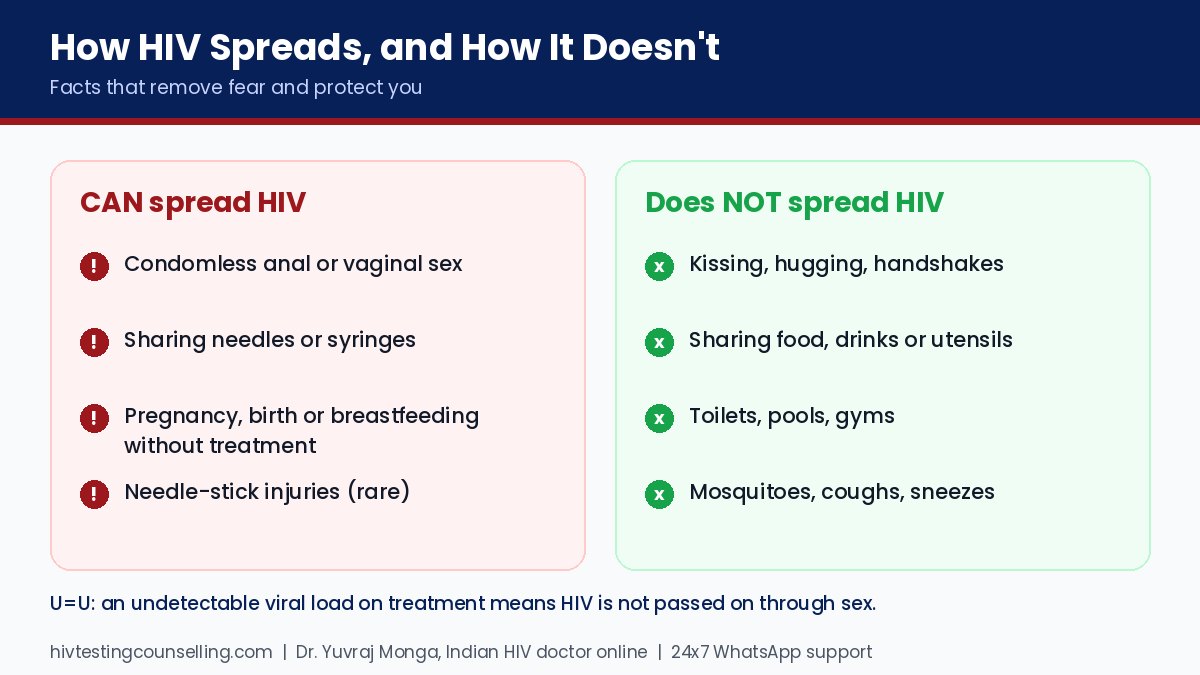
HIV can spread through
- Condomless anal or vaginal sex
- Sharing needles or injecting equipment
- Pregnancy, birth or breastfeeding (preventable with treatment)
- Rarely, needle-stick injuries in healthcare
HIV does NOT spread through
- Kissing, hugging or shaking hands
- Sharing food, drinks or utensils
- Toilets, swimming pools or gyms
- Mosquitoes, coughing or sneezing
Oral sex carries a very low risk. Having another STI, such as syphilis or gonorrhoea, raises the risk of HIV transmission. Read how STDs raise HIV risk. To judge a specific situation, see our guides to exposure with an unknown partner and exposure with a known partner.
The Stages of HIV
| Stage | When | What happens |
|---|---|---|
| 1. Acute HIV | 2–4 weeks after infection | Some people have a flu-like illness; the viral load is very high and HIV passes on easily. |
| 2. Chronic HIV | Years, often without symptoms | The virus slowly damages the immune system. With treatment, this stage can last a normal lifetime. |
| 3. AIDS | Without treatment, often after 8–10 years | Severe immune damage and serious infections. Treatment can still help. |
Symptoms of HIV
Some people develop symptoms 2–4 weeks after infection: fever, sore throat, rash, swollen glands, muscle aches, tiredness, night sweats or mouth ulcers. Many people notice nothing at all. Because these symptoms are common in everyday illness, and in anxiety, only a test can tell you whether you have HIV. Read more about early HIV symptoms.
Testing for HIV
HIV tests look for the virus, its p24 antigen or antibodies. The right test depends on how long ago the exposure was. See our guides to early HIV testing and the HIV window period.
Treatment: What ART Can Do Today
Antiretroviral therapy (ART) is a combination of HIV medicines, often just one pill a day. It cannot cure HIV, but it stops the virus multiplying. Most people reach an undetectable viral load within about six months of starting treatment, and their immune system recovers.
Learn more about HIV treatment options, viral load and CD4 and staying on track with HIV medication.
How to Prevent HIV
- Condoms used correctly every time.
- PEP, emergency medicine started within 72 hours after a possible exposure. See PEP explained.
- PrEP, medicine taken before exposure by people at ongoing risk. Read who should consider PrEP.
- Treatment as prevention: partners with undetectable viral loads do not transmit HIV.
- Never sharing needles, and regular STI testing.
More on protection.
Living Well With HIV
A diagnosis today is the start of a manageable, long-term condition, not the end of a normal life. Living well with HIV usually means:
- Taking treatment every day and attending regular viral load and CD4 checks.
- Looking after overall health: vaccinations, a balanced diet, exercise, no smoking and limited alcohol.
- Mental and emotional support: counselling for the shock of diagnosis, disclosure and relationships.
- Safe relationships: with an undetectable viral load, HIV is not passed on through sex; partners can also take PrEP.
Read the HIV care continuum, from diagnosis to undetectable.
HIV, Pregnancy and Having Children
People living with HIV can have healthy, HIV-negative children. With effective treatment before and during pregnancy, a safe delivery plan and appropriate infant care, the risk of passing HIV to a baby becomes very small. Mixed-status couples, where one partner has HIV, can also conceive safely, especially when the partner with HIV has an undetectable viral load. Family planning counselling helps couples prepare.
Talking to Partners and Family
Deciding whom to tell, and when, is one of the hardest parts of an HIV diagnosis or exposure. There is no single right way. Counselling can help you plan what to say, anticipate reactions and protect your privacy. Our sister site has a practical guide on how to talk to your partner about an HIV exposure.
Getting Care in India and Abroad
In India, HIV testing and treatment are available free of charge through government ART centres under NACO, as well as through private specialists. Outside India, care comes from licensed providers where you live. Dr. Yuvraj Monga, an Indian HIV specialist, counsels people worldwide online and sees patients in person in Delhi NCR. Guides: India · USA · Canada · Dubai & UAE.
HIV Myths vs Facts
| Myth | Fact |
|---|---|
| HIV is a death sentence. | With treatment, people with HIV live long, healthy lives. |
| You can tell someone has HIV by looking at them. | Most people with HIV look and feel well. Only a test can tell. |
| People with HIV can't have children. | With treatment, people with HIV can have HIV-negative babies. |
| HIV spreads through casual contact. | It does not. Everyday contact carries no risk. |
Frequently Asked Questions
What is the difference between HIV and AIDS?
HIV is the virus. AIDS is the most advanced stage of untreated HIV infection. With early treatment, most people with HIV never develop AIDS.
How is HIV transmitted?
Through blood, semen, pre-seminal fluid, vaginal and rectal fluids and breast milk, mainly during condomless sex, by sharing needles, or from parent to baby without treatment.
Can HIV spread through kissing?
No. Kissing, hugging, sharing food and using the same toilet do not spread HIV.
What are the first symptoms of HIV?
Some people have a flu-like illness 2 to 4 weeks after infection, with fever, sore throat, rash or swollen glands. Many have no symptoms.
Is HIV curable?
There is no routine cure yet, but treatment (ART) controls the virus so well that people with HIV can live normal lifespans.
What does U=U mean?
Undetectable equals untransmittable: a person with HIV who has an undetectable viral load on treatment does not pass HIV to sexual partners.
How can I protect myself from HIV?
Use condoms, consider PrEP if you are at ongoing risk, seek PEP within 72 hours after a possible exposure, never share needles and test regularly.
Can I talk to an Indian HIV doctor online?
Yes. Dr. Yuvraj Monga consults people worldwide on WhatsApp, voice or video, with 24x7 support.
Sources and Further Reading
Trusted sources
From our sister site, PEP Treatment for HIV
Related guides
Online HIV counselling where you live
Medical note: This guide is for education and does not replace a consultation with a doctor. If an exposure happened in the last 72 hours, seek PEP at a hospital or clinic now. Outside India, tests and prescriptions come from a provider licensed where you live.