 Medically reviewed by Dr. Yuvraj Monga, MBBS, MD, Indian HIV & STD specialist · Updated
Quick answer
PEP (post-exposure prophylaxis) is a 28-day course of HIV medicines that can prevent infection after a possible exposure. It must start as soon as possible and no later than 72 hours after the exposure, ideally within 24 hours. After 72 hours, PEP is not recommended: instead, get an HIV test now, plan follow-up tests and ask about PrEP if the risk continues. After a full PEP course, HIV tests are done at 4–6 weeks and a final test at 12 weeks.
What Is PEP and How Well Does It Work?
PEP is emergency HIV prevention. After a possible exposure, HIV takes a short time to establish infection. Antiretroviral medicines taken during that time can stop it. A full PEP course is 28 days of daily tablets.
PEP works best when started early and taken without missing doses. Studies of healthcare workers exposed to HIV found that taking PEP cut the risk of infection by about 80%, and starting sooner gives better protection. PEP is for emergencies: if you are often at risk, PrEP is the better long-term option.
When is PEP recommended?
- Sex without a condom, or a condom that broke or slipped, with a partner who has HIV or whose status you don't know.
- Sharing needles or other injecting equipment.
- Sexual assault.
- A needle-stick or other injury at work involving blood.
Not sure if your situation counts? Our guides on high-risk situations, sex with an unknown partner and a partner with HIV will help, or message us for a private assessment.
PEP Time Frame: Why Every Hour Counts
The PEP time frame is the period in which PEP can still work. Guidelines from the US CDC (2025) and the World Health Organization agree:
| Time since exposure | What to do |
|---|---|
| 0–2 hours | Best possible time. Go to an emergency department or sexual health clinic now. |
| Up to 24 hours | Ideal window. PEP is most effective when started within a day. |
| 24–72 hours | Still start PEP. Don't wait for a test result or symptoms. |
| More than 72 hours | PEP is not recommended. Test for HIV, plan follow-up tests and discuss PrEP. |
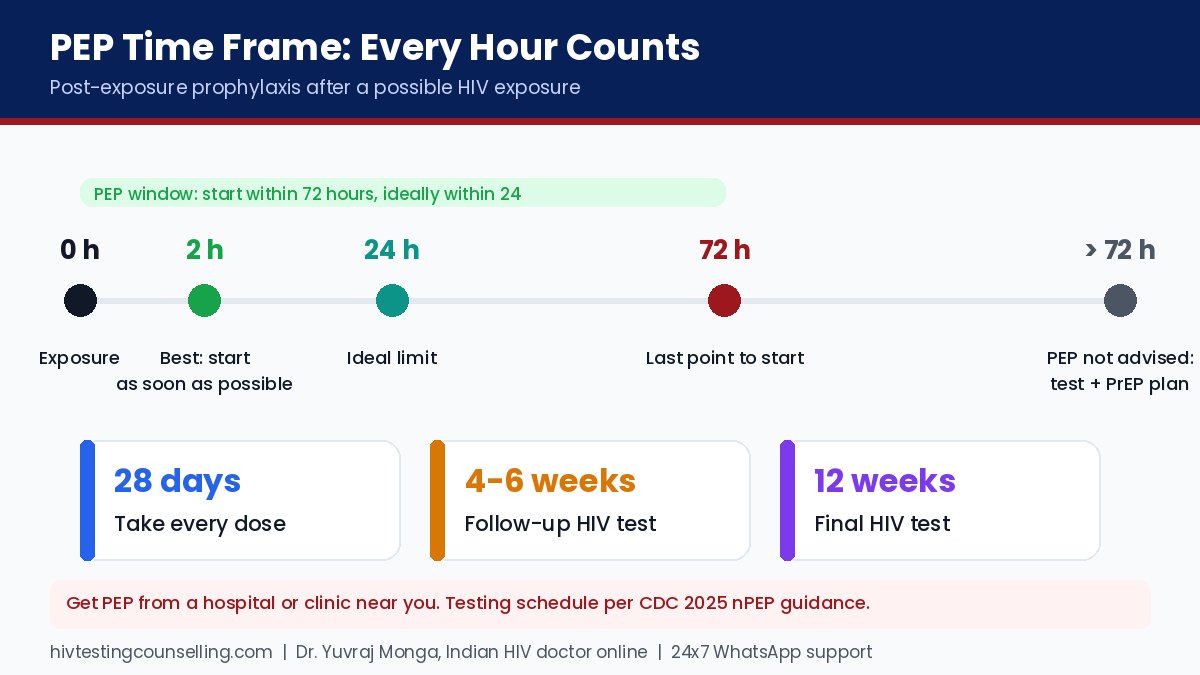
Night or weekend? Emergency departments can start PEP at any hour; read what to do in the first 72 hours.
PEP After 72 Hours: What to Do Instead
If more than 72 hours have passed, the 2025 CDC guidance says PEP should not be started, because there is little evidence it still works and it delays other steps. That doesn't mean there is nothing to do:
- Get a baseline HIV test nowIt shows your status before this exposure.
- Plan follow-up testsA 4th-generation test at about 6 weeks and a final test at 12 weeks; a NAT test can be added if your doctor advises it.
- Test for other STIsGonorrhoea and chlamydia from about 2 weeks, syphilis from about 6 weeks.
- Ask about PrEPIf the risk is likely to happen again, PrEP can protect you going forward.
Search engines often show “72 hours treatment” or “PEP after 72 hours”. The honest answer is that the 72-hour limit is real, and the best next step is a clear testing plan. That is exactly what a counselling session gives you.
Which Medicines Are Used for PEP?
PEP is always a combination of three medicines. Common choices are:
- WHO and India: tenofovir (TDF) + lamivudine (3TC) or emtricitabine (FTC) + dolutegravir (DTG).
- CDC (USA, 2025): bictegravir/emtricitabine/tenofovir alafenamide (one tablet a day), or dolutegravir plus tenofovir with emtricitabine or lamivudine.
Your doctor chooses the regimen based on kidney and liver health, pregnancy, other medicines and local availability. Never buy PEP without a prescription or take leftover medicines from someone else.
PEP Side Effects and How to Manage Them
Modern PEP is usually well tolerated. The most common side effects are nausea, headache, tiredness, diarrhoea and an upset stomach, and they usually ease within the first one to two weeks.
- Take your dose with food and at the same time each day.
- Ask about anti-nausea medicine instead of skipping doses.
- A fever with rash or sore throat during or after PEP is not a typical side effect: get checked and tested promptly.
Read our sister site's guide to PEP side effects.
PEP Window Period: HIV Testing After PEP
PEP can delay the point at which an infection, if one happened, shows up on a test. That is why testing after PEP follows a set schedule (CDC 2025):
| When | Test |
|---|---|
| Before starting PEP | Rapid or lab HIV antigen/antibody test, plus kidney, liver and hepatitis B checks. The first dose is not delayed for results. |
| 4–6 weeks after exposure | Lab antigen/antibody test plus HIV NAT. |
| 12 weeks after exposure | Final antigen/antibody test plus NAT to rule out HIV. |
See our full HIV window period guide for every test type.
Where to Get PEP Near You
PEP must come from a doctor or clinic where you are, because it cannot wait for delivery. Options include hospital emergency departments, sexual health or STI clinics, and in India, government hospitals and ART centres. Country guides: USA, Canada, Dubai & UAE, India. For a list of ways to get tested afterwards, see HIV testing near me.
Once you have started PEP, Dr. Monga can help with side effects, missed doses and the anxiety of the 28 days, by WhatsApp, 24x7.
Frequently Asked Questions
What is the time frame for PEP?
PEP should start as soon as possible and no later than 72 hours after a possible HIV exposure, ideally within 24 hours. The course lasts 28 days.
Can I take PEP after 72 hours?
No. Current CDC guidance does not recommend starting PEP after 72 hours. Instead, get an HIV test now, plan follow-up tests at about 6 and 12 weeks, and ask about PrEP if the risk may happen again.
What is the PEP window period for HIV testing?
After PEP, HIV testing is recommended at 4 to 6 weeks and again at 12 weeks after the exposure, using an antigen/antibody test plus a NAT test according to CDC 2025 guidance.
How effective is PEP?
Started early and taken for the full 28 days, PEP greatly lowers the chance of HIV infection; studies in healthcare workers found about an 80% reduction. Delays and missed doses reduce protection.
Is a negative HIV test during PEP reliable?
Not on its own. PEP can delay detection, so keep taking every dose and complete the follow-up tests at 4 to 6 weeks and 12 weeks.
Can I get PEP online?
PEP must be prescribed and started by a doctor or clinic where you are, usually the same day. Dr. Monga can guide you to the right place and support you through the course online.
Sources and Further Reading
Trusted sources
From our sister site, PEP Treatment for HIV
Related guides
Online HIV counselling where you live
Medical note: This guide is for education and does not replace a consultation with a doctor. If an exposure happened in the last 72 hours, seek PEP at a hospital or clinic now. Outside India, tests and prescriptions come from a provider licensed where you live.